Every year, thousands of computer science graduates walk out of university halls with top marks in algorithms and data structures, only to experience severe whiplash during their first week in the software industry.
The tools they encounter on day one—Docker, Kubernetes, distributed message queues, CI/CD pipelines, memory profilers, observability stacks—never really appeared on their exam papers. The immediate reaction is usually frustration: Why is the syllabus so hopelessly outdated? Why didn't college teach us industry tech?
The truth is that academic syllabi aren't outdated by accident. They are outdated by definition.
More importantly, expecting a university to teach you production software engineering is a fundamental category error. University gives you the mathematical engine—it's up to you to build the production-grade car 🏎️
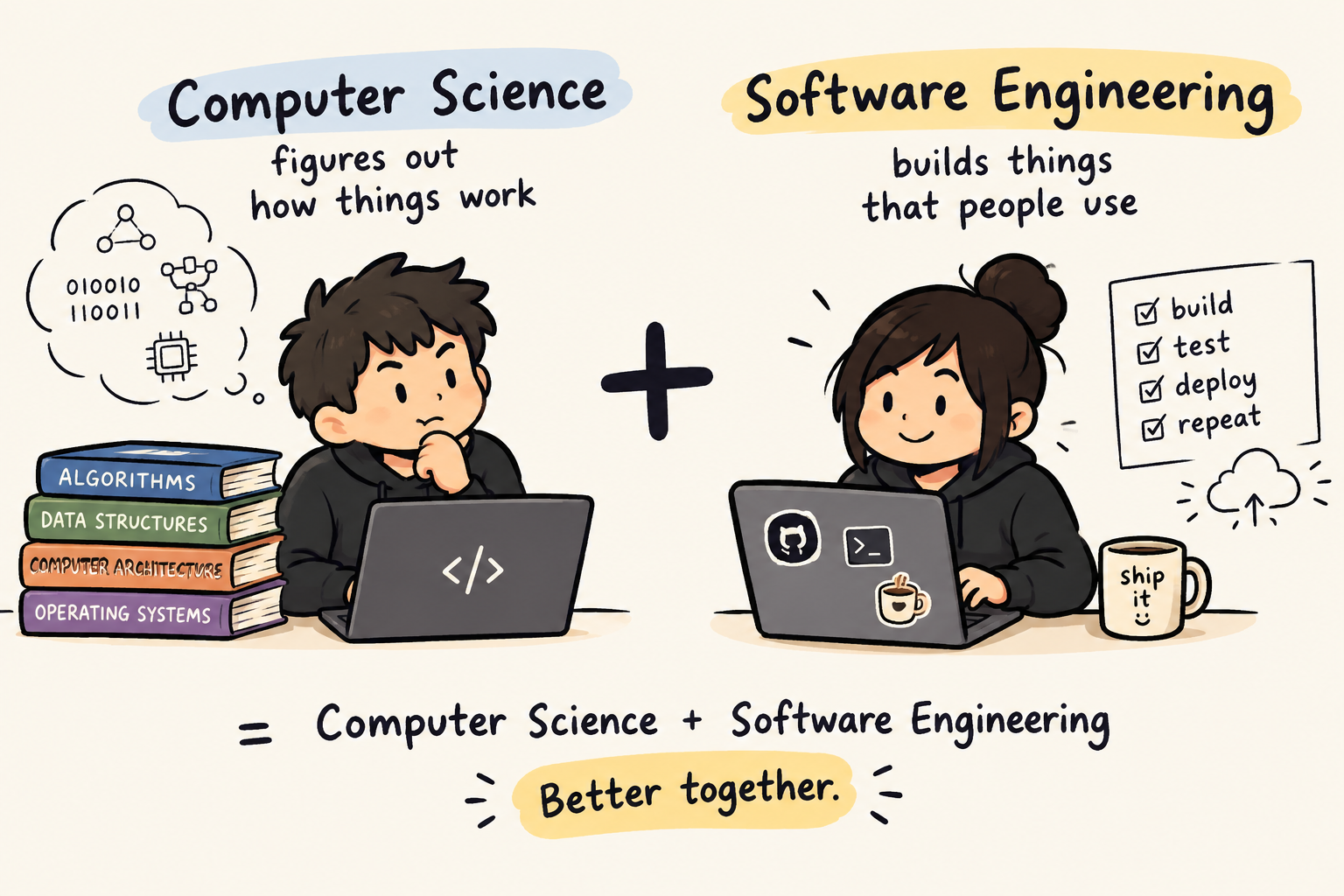
Computer Science $\neq$ Software Engineering
The confusion starts with the name of the degree itself.
Most universities teach Computer Science. Industry, on the other hand, hires for Software Engineering. While they share common roots, they are completely different disciplines with different incentives:
- Computer Science is a branch of mathematics and formal logic. It explores questions of computability, asymptotic complexity ($O(n \log n)$ vs $O(n^2)$), automata theory, and formal proofs. In computer science, an algorithm is "done" when it is mathematically correct.
- Software Engineering is a systematic discipline forced to deal with the messy, human reality of designing, building, maintaining, and scaling large systems under hardware limits, business constraints, corrupt data, and team collaboration.
A syllabus designed around computer science can never keep pace with modern software tooling because tools change every few years, or even months, while foundational theory remains static.
By the time it takes for academic committee to schedule a meeting to update a textbook, the JavaScript ecosystem already has a new framework 💀
The 50-Line Sandbox vs. The 500,000-Line Codebase
The key contrast between academia and industry lies in the scope and lifecycle of the code you write.
In university, programming assignments exist in what can best be described as a sandbox:
- You write 50 to 200 lines of code in a single file (
main.corSolution.java). - The input format is perfectly specified and predictable.
- The code runs once against a handful of test cases some professor generated using AI.
- You get an 'A', and the file is deleted or forgotten forever.
In production, almost nothing works this way:
- You rarely write code from scratch: 80% of your job is figuring out what some engineer named @bugslayer69 wrote three years ago, why it works, and whether touching it will summon production incidents.
- Inputs are hostile and corrupted: Disks fill up at the worst possible moment, networks drop packets like they have personal issues, JSON arrives missing half its keys, and third-party APIs respond with HTTP 500 just to remind you who’s really in charge.
- Code lives for years: The code you write today will outlive your team, your manager, and possibly the company. So yes, that “quick hack” needs documentation, tests, backwards compatibility, and probably a small prayer for whatever database schema someone created three years ago.
When all your academic training is evaluated on whether a function produces the right output under ideal conditions, you are unprepared for the reality that in production, handling failure is the job.
What Academia Actually Gets Right: The Timeless Engine
After all that, you might think that the hot take now is that CS degrees are relics. Apparently, we’ve decided that knowing how computers work is optional because ChatGPT can autocomplete our bugs — turns out, computers still expect you to understand what the hell they’re doing.
While universities fail at teaching modern software engineering workflows, they excel at teaching the foundational primitives that underpin all of computing:
- Memory layouts and pointers: Understanding heap vs. stack allocation, alignment, and virtual memory.
- Operating systems internals: Process scheduling, context switching, file descriptors, and system calls.
- Networking fundamentals: The TCP/IP stack, socket programming, packet loss, and handshakes.
- Discrete mathematics & graphs: State machines, trees, and hashing mechanisms.
- DSA: Yep, those “useless” algorithms quietly running underneath everything you use.
The Half-Life of Tech Knowledge
Consider the half-life of technical skills:
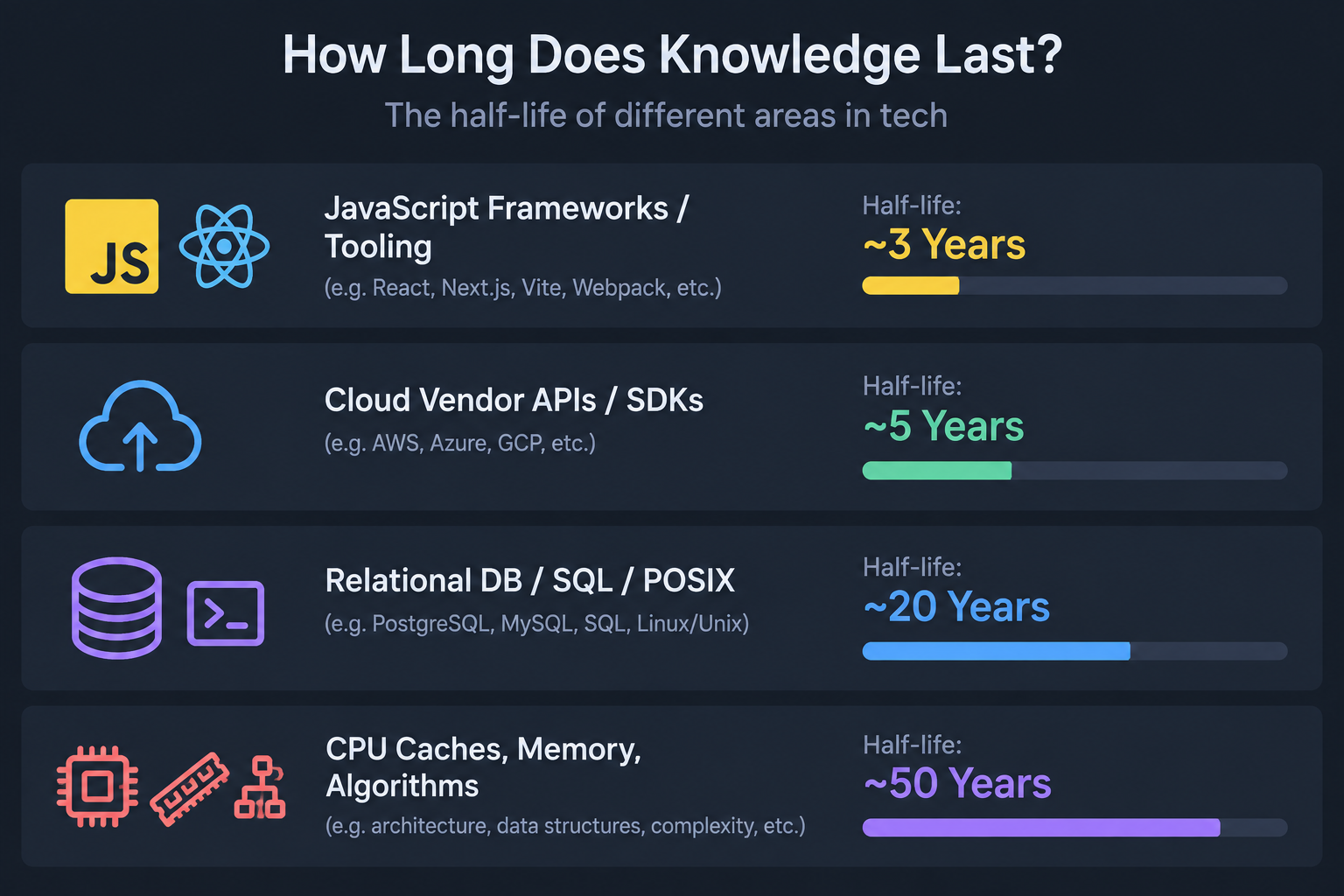
If universities revamped their curriculum every two years to teach whatever web framework or cloud vendor is currently trending, your education would expire before your student loans are paid off 🤓
The timeless theory is the engine. When you deeply understand memory hierarchy, concurrency primitives, and OS system calls, learning a new programming language or framework becomes a matter of a single weekend.
The Missing Manual: What You Have to Learn on Your Own
Because academic programs focus on theory, you won’t find the practical day-to-day tools of the job on any exam paper. If you want to get a head start before your first day in industry, here are the three biggest mindset shifts to focus on:
1. Git as a Team Sport (Beyond the Solo Homework Run)
In college, Git is usually treated like a glorified Google Drive. You work alone on a single branch, your commit messages look like final_fix_v2_REALLY_DONE, and your entire workflow is git add . and git push origin main.
In the real world, you are building software alongside twenty other engineers who are editing the same files at the same time. The real skill isn't knowing how to push code—it’s knowing how to collaborate:
- Writing clean, small pull requests so your teammates can review your work without a headache.
- Resolving merge conflicts calmly when someone else touched the lines you were working on.
- Using
git bisectto travel back in time and find the exact commit that broke something three months ago.
2. Upgrading from the printf("HERE 1") Panic
We’ve all done it: a program crashes, so you scatter twenty printf or console.log statements throughout the file, re-run the code, and pray you spot where it died.
That works when your file has 50 lines. When your codebase has 50,000 lines, guessing like this burns entire afternoons. Real engineering is about letting diagnostic tools do the detective work for you:
- Sanitizers (like ASan): Think of them as instant bug-catchers. They stop your program the exact millisecond you access memory you shouldn't, pointing you directly to the offending line.
- Profilers: Stop guessing "I think this function is slow." A profiler draws a visual map showing you exactly which lines of code are hogging 90% of your CPU.
- Helpful Logging: Writing logs that tell a clear story, so when an error happens, you know why it broke instead of just that it broke.
3. Expecting Everything to Go Wrong
In university assignments, you write code for a polite, perfect world. The user always types a valid number, the file is always on disk, and the network is always instant.
In production, chaos is the default:
- A user will try to upload an entire 4 GB movie into a profile picture slot.
- The payment server will randomly drop the connection mid-transaction.
- A third-party API will freeze for 15 seconds instead of responding in 50 milliseconds.
Real engineering isn’t just about making code work when everything goes right—it’s about making sure your app doesn't collapse when things go wrong. It means asking simple, defensive questions:
- "What should happen if the server never responds?" (Timeouts & retries)
- "What if the user double-clicks the Buy button?" (Preventing duplicate charges)
- "What if 10,000 people open this page at the same time?" (Protecting memory)
The Bottom Line: Nobody Is Coming to Teach You This
Waiting for your college syllabus to make you job-ready is like expecting a physics textbook to teach you how to drive a Formula 1 car. It’s the wrong tool for the job.
The most dangerous trap is thinking that good grades equal good engineering. The developers who thrive in industry are the ones who treat their degree as a foundation, not the finish line:
- Stop writing disposable code: Treat your personal projects like software that will run in production for years. Add error handling, write clear documentation, and test what happens when bad data enters.
- Get comfortable under the hood: Don't just accept that a library "does magic." Dig into the source code and find out how it does that magic.
- Learn to debug like an adult: Trade
printfguesswork for profilers, sanitizers, and diagnostic tools that respect your time.
Your syllabus is a fossil. Stop waiting for it to change, and start building what matters.